


Changing hair color may seem like a simple beauty transformation, but behind every shade is a fascinating chemical process. Whether hair is being lightened, darkened, covered with a new tone, or given a temporary color, chemistry plays a central role in determining the final result.
Understanding the chemistry of hair color helps explain why different products work in different ways, why some colors last longer than others, and why factors such as hair condition, natural pigment, and processing time matter.
For anyone interested in professional cosmetology, learning this science provides an important foundation for making informed decisions about hair services.
Hair Color Starts With Melanin
The natural color of human hair comes primarily from pigments called melanin. Melanin is produced by specialized cells called melanocytes within the hair follicle and is incorporated into the growing hair fiber.
There are two main types of melanin involved in natural hair color:
- Eumelanin contributes primarily to brown and black shades.
- Pheomelanin contributes primarily to yellow, gold, and red shades.
The amount and combination of these pigments determine an individual’s natural hair color. Differences in pigment concentration explain why two people with apparently similar hair colors can respond differently to the same coloring process.
As hair ages, melanocyte activity can decrease, resulting in less melanin being deposited into new hair. This is one of the reasons gray or white hair develops.
The Structure of Hair Matters
To understand how hair color products work, it is useful to understand the structure of the hair fiber. Hair is primarily composed of a protein called keratin and has three main layers: the cuticle, cortex, and medulla.
The cuticle is the outermost layer. It consists of overlapping cells that protect the inner portions of the hair. Its condition affects how easily chemicals can penetrate the hair.
The cortex lies beneath the cuticle and contains most of the hair’s keratin, strength, and natural pigment. Because the cortex contains melanin, many permanent color and lightening processes are designed to reach this layer.
The medulla is the innermost region and may be absent in very fine hair. It generally has less influence on hair coloring than the cuticle and cortex.
When hair is colored, the condition and porosity of these layers influence how evenly color is absorbed and how long the result lasts.
What Happens During Permanent Hair Coloring?
Permanent hair color typically involves several chemical processes working together. Many permanent color formulations use an alkalizing agent, such as ammonia or an alternative alkalizer, along with an oxidative developer containing hydrogen peroxide.
The alkalizing component helps raise or swell the cuticle, making it easier for the coloring mixture to enter the hair. The developer then participates in oxidation reactions.
This is important because permanent color does not simply place a layer of pigment on the outside of the hair. Instead, chemical reactions allow certain color-forming molecules to develop within the hair fiber.
Small dye precursors can penetrate into the cortex. In the presence of an oxidizing agent, these molecules undergo chemical reactions that produce larger colored molecules. Because these molecules become relatively large within the hair, they are more difficult to remove through ordinary washing.
This combination of pigment modification and new color formation is what gives permanent hair color its characteristic durability.
The Chemistry of Bleaching
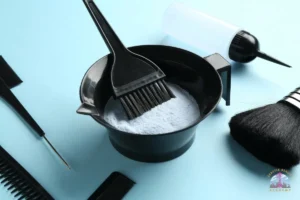
Lightening hair is a different process. Instead of primarily adding color, bleaching aims to remove or break down existing melanin pigments.
Bleaching products commonly contain an alkaline component and an oxidizing agent, often hydrogen peroxide. The alkaline environment helps the product penetrate the hair, while the oxidizing chemistry breaks down melanin into smaller, less strongly colored compounds.
The amount of lightening depends on several factors, including the concentration of the developer, processing time, starting hair color, hair condition, and formulation.
However, bleaching does not necessarily make hair completely colorless. As dark natural pigment is broken down, underlying warm tones can become visible. Hair may progress through reddish, orange, and yellow stages as it becomes lighter.
This is why professional colorists need to understand the underlying pigment present at different levels of lightness. Correcting or balancing these tones requires knowledge of color theory as well as chemistry.
Why Hair Color Can Change Over Time
Even permanent hair color is not chemically permanent forever. Washing, exposure to sunlight, heat, water, and environmental factors can gradually affect the color.
Hair is also a porous material. Repeated chemical treatments can alter the physical structure of the fiber, potentially changing how it absorbs and releases color molecules.
Semi-permanent and temporary colors behave differently because they generally rely more heavily on depositing color near the surface or within accessible areas of the hair rather than creating the same type of permanent oxidative color formation.
The distinction between temporary, semi-permanent, demi-permanent, and permanent color is therefore not simply a marketing classification. Each category reflects differences in formulation, chemical action, penetration, and durability.
Why Hair Condition Affects Color Results
Hair that has been chemically treated, heat-damaged, or otherwise compromised may behave differently from healthy, untreated hair.
Porosity is particularly important. Highly porous hair can absorb certain color molecules quickly, but it may also release them more easily during washing. Uneven porosity can lead to uneven color absorption, making some areas appear darker or more saturated than others.
This is one reason professional hair color services involve more than selecting a shade from a chart. A colorist must consider the starting level, underlying pigment, previous chemical services, hair condition, desired result, and the chemistry of the chosen formulation.
A scientific understanding of these factors helps professionals approach color services systematically rather than relying entirely on trial and error.
Color Theory and Chemistry Work Together
Chemistry explains how coloring products interact with hair, while color theory helps professionals predict how different pigments will appear when combined.
The familiar color wheel is particularly useful when unwanted tones need to be balanced. Opposite colors on the wheel can help neutralize one another. For example, violet is commonly used to counteract excessive yellow, while blue can help balance orange tones.
In practice, however, professional color correction is more complex than simply choosing an opposite color. The hair’s underlying pigment, level of lightness, porosity, existing artificial color, and desired result all influence the formulation.
This combination of chemistry, color theory, observation, and technical skill is what makes professional hair coloring both a science and a craft.
Learning the Science Behind the Service
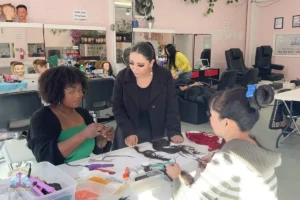
For students studying cosmetology, understanding the chemistry of hair color can make practical techniques easier to understand. Instead of memorizing isolated procedures, students can learn why particular products are selected, how different formulations interact with hair, and what factors can influence the outcome.
Our cosmetology program incorporates the scientific principles behind professional beauty services as part of a broader education in hair, skin, and beauty care.
Learning the chemistry behind hair color is one example of how cosmetology connects scientific knowledge with hands-on technical practice.
Ultimately, successful hair coloring is not just about choosing a beautiful shade. It involves understanding the structure of hair, the behavior of natural and artificial pigments, oxidation, chemical reactions, and the condition of the hair being treated.
The next time you see a dramatic hair color transformation, remember that there is much more happening beneath the surface. Behind the finished shade is a carefully controlled interaction between chemistry, hair biology, color theory, and professional technique.
Seattle Beauty Academy is a licensed beauty school in Washington, we offer flexible schedules, experienced instructors, and hands-on training.
👉 Learn more our Cosmetology Program here !