

Every great facial starts with one thing: knowing exactly what’s in front of you. Before a single product touches a client’s face, a trained esthetician has already asked — and answered — one essential question: what type of skin am I working with?
Learning to recognize esthetician skin types is one of the very first skills students master at Seattle Beauty Academy’s Esthetics Program — because everything else, from product selection to treatment planning, depends on it. Skin isn’t one-size-fits-all, and treating it that way is one of the fastest ways to get poor results or, worse, cause irritation.
Here’s a breakdown of the esthetician skin types every beauty professional needs to recognize with confidence.
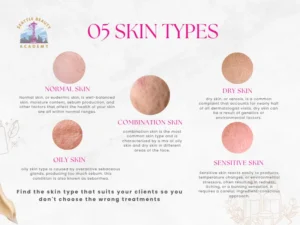
The 5 Esthetician Skin Types: Normal, Oily, Dry, Combination, Sensitive
Normal Skin
Normal skin is well-balanced — not too oily, not too dry. Pores are typically small, texture is even, and the skin rarely reacts negatively to new products. While it may seem like the “easy” skin type, estheticians still need a maintenance plan to keep it balanced, since normal skin can shift with age, season, or hormones.
What to look for: even tone, minimal sensitivity, small pores, balanced oil production.
Oily Skin
Oily skin produces excess sebum, often leading to a shiny appearance, enlarged pores, and a higher likelihood of breakouts. It’s commonly misunderstood — many clients with oily skin over-strip their face with harsh products, which can actually trigger the skin to produce even more oil.
What to look for: visible shine (especially in the T-zone), frequent blackheads or breakouts, thicker skin texture.
Esthetician’s role: recommend gentle, non-stripping cleansers and treatments that regulate oil rather than eliminate it entirely.
Dry Skin
Dry skin lacks sufficient oil and often feels tight, rough, or flaky. It’s more prone to fine lines becoming visible and can be sensitive to certain active ingredients if not properly hydrated first.
What to look for: flakiness, dull texture, tightness after cleansing, visible fine lines.
Esthetician’s role: prioritize hydration and barrier-repair techniques, and avoid over-exfoliating.
Combination Skin
Combination skin is exactly what it sounds like — oily in some areas (usually the T-zone) and dry or normal in others (typically the cheeks). It’s one of the most common skin types estheticians encounter, and also one of the trickiest to treat, since a single product often isn’t right for the entire face.
Esthetician’s role: learn to zone treatments — balancing oil control in some areas while adding hydration in others.
Sensitive Skin
Sensitive skin reacts easily to products, temperature changes, or environmental stressors, often resulting in redness, itching, or a burning sensation. It requires a careful, ingredient-conscious approach.
What to look for: redness, visible capillaries, reactions to new products, discomfort during treatments.
Esthetician’s role: patch test when needed, use calming and fragrance-free products, and build trust with the client through a gentle approach.
Why This Knowledge Matters
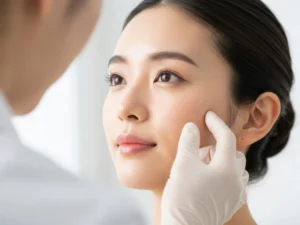
Recognizing skin type isn’t just theory — it directly shapes the treatment plan, product recommendations, and even the pressure and technique used during a facial. A skilled esthetician reads the skin the way a stylist reads hair texture: it’s the foundation everything else is built on.
This is exactly why Seattle Beauty Academy’s Esthetics Program puts students in front of real, live clients early — because skin type isn’t something you memorize from a textbook and forget. It’s something you learn to recognize instinctively, treatment after treatment, client after client.
Real Training, Real Confidence
That hands-on approach is something SBA graduates consistently point back to when they talk about their experience. Lorenzo Hill, a graduate of Seattle Beauty Academy’s Esthetics Program, shared that from his very first day, he was already working and learning new skills on his way to becoming a licensed esthetician. That immersive, client-facing approach — rather than weeks of purely theoretical learning — is central to how SBA prepares students to walk into a treatment room and read skin with real confidence.

Ready to Learn Hands-On?
Understanding skin types is just the beginning. Seattle Beauty Academy’s Esthetics Program is 750 hours of hands-on, instructor-led training designed to prepare students for Washington State licensure — with small class sizes and live client practice from day one.
Want to build the skills to read any skin type with confidence? Explore our Esthetics Program in Washington and schedule a visit with us.